
2021 words 8 minute read - Let’s do this!
Another Crazy Thursday here at Port X Logistics ! If there's one thing the freight market has taught us this year, it's to stop expecting it to behave normally. August U.S. imports just landed among the three highest monthly totals ever recorded. Rail traffic gave us a very different signal this week. Diesel blew straight through $6 per gallon, prompting federal action to help keep fuel moving. And internationally, container carriers are putting more ships back through the Suez Canal while conditions elsewhere in the Middle East remain volatile. Confused yet? Perfect. You're officially caught up on 2026 logistics. This week isn't really about one giant disruption. It's about diverging signals — strong cargo volume in one part of the network, weakness in another, changing modal economics and global events thousands of miles away suddenly affecting transportation decisions here at home. Let's get into it. And don’t forget to follow Port X Logistics on LinkedIn for real-time insights—or have our Thursday Market Updates delivered straight to your inbox by reaching out to Marketing@portxlogistics.com.
Remember all the predictions that the early peak season would leave late summer relatively quiet? August apparently didn't get the memo. New data shows U.S. containerized imports reached 2.604 million TEUs in August, increasing 3.8% from July and 3.3% from August 2025. Even more impressive, it was the third-highest monthly U.S. import volume on record, trailing only May 2022 and July 2025. That's significant because importers spent much of the first half of 2026 pulling inventory forward amid tariff uncertainty and concern about future transportation costs. Conventional wisdom suggested that would steal volume from the traditional late-summer peak. Instead, imports kept coming. Cargo from Asia was particularly strong, with U.S. container imports from ten major Asian sourcing markets reaching approximately 1.89 million TEUs in August, up about 2% year over year.
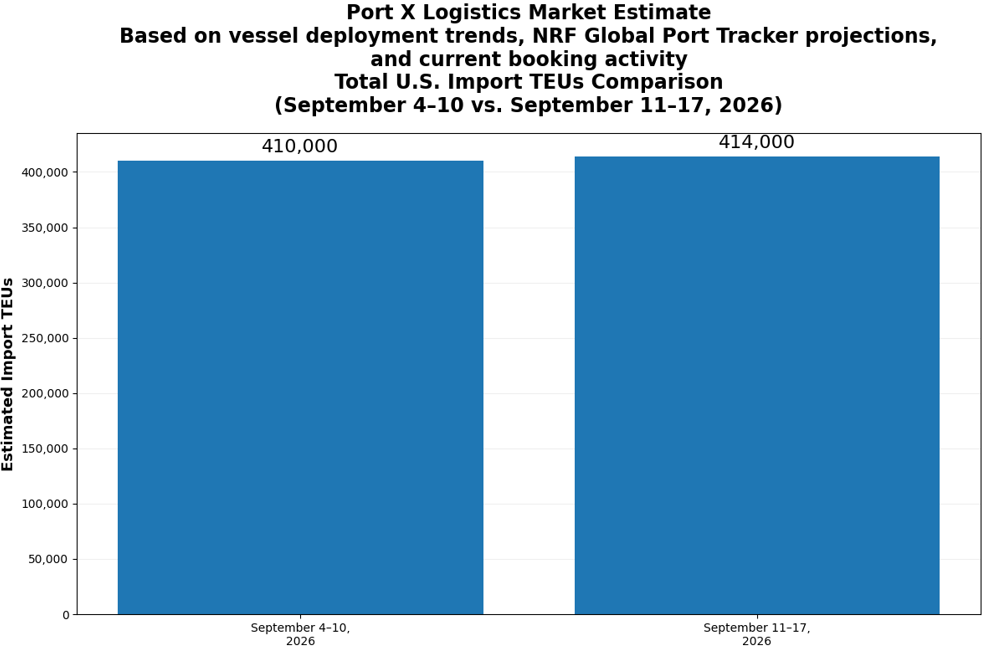
September isn't necessarily providing the expected cooldown either. The latest Global Port Tracker forecast still calls for approximately 2.31 million TEUs through the major retail container ports this month, with delayed vessels from severe weather in China and some Panama-related rerouting contributing to an extended import cycle. This isn't one traditional peak-season surge anymore. Frontloading, delayed freight, continued consumer demand and changing sourcing patterns are creating multiple waves of cargo.
What It Means for Shippers
Don't plan the rest of September based on the assumption that peak season is over, and don't confuse available ocean capacity with available supply-chain capacity. High import volume eventually reaches terminals, rail ramps, warehouses, transload facilities and trucks. Forecast inbound volume as far ahead as possible, secure receiving capacity early and watch actual vessel arrivals, particularly when overseas weather has caused schedules to bunch. The import market isn't simply slowing down. It's changing shape.
Meanwhile, the latest national rail numbers are telling a very different story. U.S. railroads moved 494,865 carloads and intermodal units during the week ending September 12, down 3.7% from the same week last year. Carloads fell 3.3%, while intermodal containers and trailers dropped 4.1% year over year to 271,305 units. But here's where it gets interesting: one week earlier, total U.S. rail traffic had been up 13.8% year over year, with intermodal jumping 18%. The dramatic swing illustrates exactly why one isolated weekly number doesn't necessarily tell us where the freight market is headed. Labor Day timing and shipment patterns can distort short-term comparisons.
Zoom out, and the picture looks considerably steadier. Through the first 36 weeks of 2026, U.S. railroads have moved more than 18.38 million carloads and intermodal units, up 3.4% from the same period last year. Intermodal volume remains 4% higher year to date, while carloads are up 2.7%. Grain and petroleum carloads increased this week, while motor vehicles and parts, chemicals and coal declined. One softer week doesn't mean rail demand suddenly disappears, but it does reinforce something we've been watching all year: freight demand isn't moving evenly across modes, commodities or weeks. And with diesel now above $6 nationally, those modal dynamics could become even more interesting.
What It Means for Shippers
Don't read a single weekly rail decline as a signal that intermodal capacity will automatically be cheap or plentiful everywhere. Year-to-date intermodal demand remains above 2025 levels, and higher trucking fuel costs could make rail economics increasingly attractive on longer-haul lanes. For freight that isn't extremely time-sensitive, this is a good time to price truck and intermodal side by side using the all-in cost and realistic door-to-door transit, not simply the linehaul rate. The cheapest mode last month may not be the cheapest mode today.
Speaking of diesel... last week we told you fuel was becoming a transportation story again. We may have underestimated how quickly. The national average price of on-highway diesel reached $6.285 per gallon for the week of September 14, according to the U.S. Energy Information Administration. That's up from $5.967 one week earlier and $5.599 on August 31. In other words, diesel has climbed almost 69 cents per gallon in two weeks.
And this week brought an important new development. Federal transportation officials announced temporary additional hours-of-service flexibility for drivers hauling gasoline and diesel, intended to help keep fuel supplies moving amid global supply disruptions and rising costs. The underlying supply picture deserves attention too. EIA expects U.S. distillate inventories — the category that includes diesel — to fall below 100 million barrels and remain below the recent five-year range through much of 2027. Tight global distillate supplies are keeping domestic prices elevated even as the broader crude-oil picture evolves. This is why diesel isn't just a trucking-company problem. It affects drayage, truckload, LTL, construction, agriculture, warehousing and final mile — and eventually the price of practically everything transported by truck.
What It Means for Shippers
Treat fuel as a moving part of your transportation budget again. Check the fuel-surcharge formula instead of looking only at the percentage on the invoice, understand which weekly benchmark your carriers use and model what another 25- or 50-cent increase would do to your landed transportation cost. For longer-haul moves, compare intermodal where service requirements allow. Most importantly, don't celebrate a cheaper base rate until you see the all-in rate. A $100 linehaul savings accompanied by a $150 fuel increase isn't a savings. It's just prettier paperwork.
Now let's leave the U.S. for a minute, because the global shipping picture is getting particularly interesting. Container carriers are continuing a gradual return to the Red Sea and Suez Canal. This week, four additional Gemini Cooperation services were announced for a return to the Suez route instead of sailing around Africa's Cape of Good Hope. They join two Gemini services already using Suez, with the first of the newly rerouted westbound sailings beginning September 19. Routing through Suez can substantially shorten Asia-Europe transit times compared with sailing around southern Africa, while also reducing the additional fuel consumption and vessel capacity tied up by longer Cape routings.
But — and this is a fairly large but — this isn't the same thing as the Middle East suddenly returning to normal. Current carrier operational notices still describe the regional situation as highly volatile. Some bookings into parts of the Middle East remain suspended or restricted, insurance availability has tightened in parts of the Red Sea, Gulf of Oman and Persian Gulf, and carriers continue to warn that operations can change quickly. We're watching two seemingly contradictory things happen simultaneously: carriers are returning to Suez because the route is operationally valuable, while geopolitical risk throughout the broader region remains elevated.
And the ripple effects aren't staying in the Middle East. Pressure on energy shipping around the Strait of Hormuz has pushed some vessels toward alternative routes. This week, an LPG carrier reportedly paid more than $5 million just for the auction premium on a Panama Canal reservation slot — not the Canal toll itself. Think about that for a second. A disruption affecting energy shipping in the Middle East can redirect vessels toward Panama, where reduced transit availability can increase competition for infrastructure used by completely different cargo markets. That's global logistics in one sentence: one chokepoint sneezes and another one catches a cold.
What It Means for Shippers
Don't interpret the return to Suez as an “all clear.” It's encouraging from a transit-time and network-efficiency perspective, but routing decisions remain fluid and security conditions can change quickly. For international freight, ask which route your service is actually using, whether transit times have changed and whether emergency, war-risk or fuel-related surcharges apply. Give critical freight more schedule buffer than the advertised port-to-port transit suggests, because right now, the shortest route on the map isn't necessarily the most predictable one.
Put all of this together and the freight market isn't giving us one clear signal this week. It's giving us several. U.S. imports are historically strong. Rail had a softer week, but year-to-date intermodal volume remains higher. Diesel has jumped almost 69 cents in two weeks. Container carriers are shortening some international routes through Suez while geopolitical instability continues to disrupt energy flows and alter vessel routing elsewhere.
That's not a freight market that's simply “tight” or “soft.” It's a freight market where the variables are changing faster than the averages. And that's exactly why logistics decisions can't be made from one rate, one headline or one weekly number. Look at the entire move. Look at the fuel. Look at the inland mode. Look at the routing. And, most importantly, have a Plan B before Plan A decides it has other plans.
We'll keep watching the moving pieces — so you can keep your freight moving.
TEU volumes went up .97% over last week, with majority coming into New York/New Jersey 16%, Los Angeles 17.2% and Long Beach 14.2%
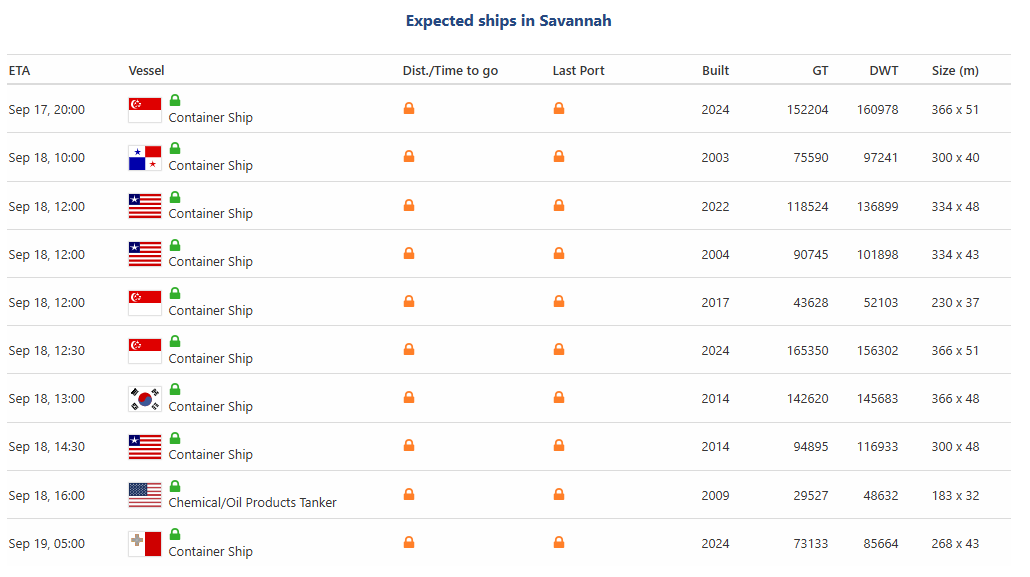
What’s happening at the ports and rails?: Savannah: Savannah is showing us the other side of the equation: big volume and better truck efficiency can coexist. The Port of Savannah handled 529,523 TEUs in August, essentially even with last year. Loaded imports increased 1.5% to 265,859 TEUs, while loaded exports climbed 4.2% to 117,242 TEUs. During July and August — the first two months of Georgia Ports Authority's fiscal year — its ports moved 1.03 million TEUs, up 2.2% from the same period last year. But here's the number we really like: 43 minutes. That's the average truck turn time at Garden City Terminal for dual import-export transactions during August — 6.5 minutes faster than the previous six-month average. And this isn't happening at a sleepy terminal. Garden City handles approximately 15,000 truck gate transactions between 4 a.m. and 6 p.m. on weekdays, with dual moves accounting for nearly 80% of truck transactions. That's an important operational win because faster turns allow drivers, chassis and equipment to accomplish more work without physically adding more capacity.
What It Means for Shippers
Port volume is only one piece of the routing decision. Port productivity matters too. For Southeast cargo, look at the entire move: vessel service, terminal efficiency, drayage availability, rail connectivity, warehouse location and final-mile distance. A gateway that can consistently turn trucks faster can create savings that never appear on the ocean quote. The cheapest port on paper isn't always the cheapest supply chain in practice.Savannah or Charleston on the routing? Send it our way. Our dedicated 12-truck drayage fleet is ready to keep your Southeast freight moving, with hazmat-certified drivers, secure yard space and a fully equipped transload warehouse backing every move. Need a container pulled before the clock starts costing you money? A last-minute cross-dock? An urgent transload that suddenly became everyone’s emergency? We’re on it. One team, local capacity and fewer handoffs between the port and final delivery. Send your next Savannah or Charleston move to letsgetrolling@portxlogistics.com and let’s get rolling!
Did You Know? Memphis is growing — and so is our fleet! 🚛 We’ve added even more drivers to our Memphis operation, giving our customers more capacity, faster response times and even more muscle when freight needs to MOVE. From pulling containers before storage starts ticking to keeping regional deliveries on schedule, our expanded fleet and hands-on dispatch team are built to keep cargo rolling when the market gets tight. More drivers. More capacity. Less waiting around. Have freight moving through Memphis? Put our growing fleet to work and email letsgetrolling@portxlogistics.com.